
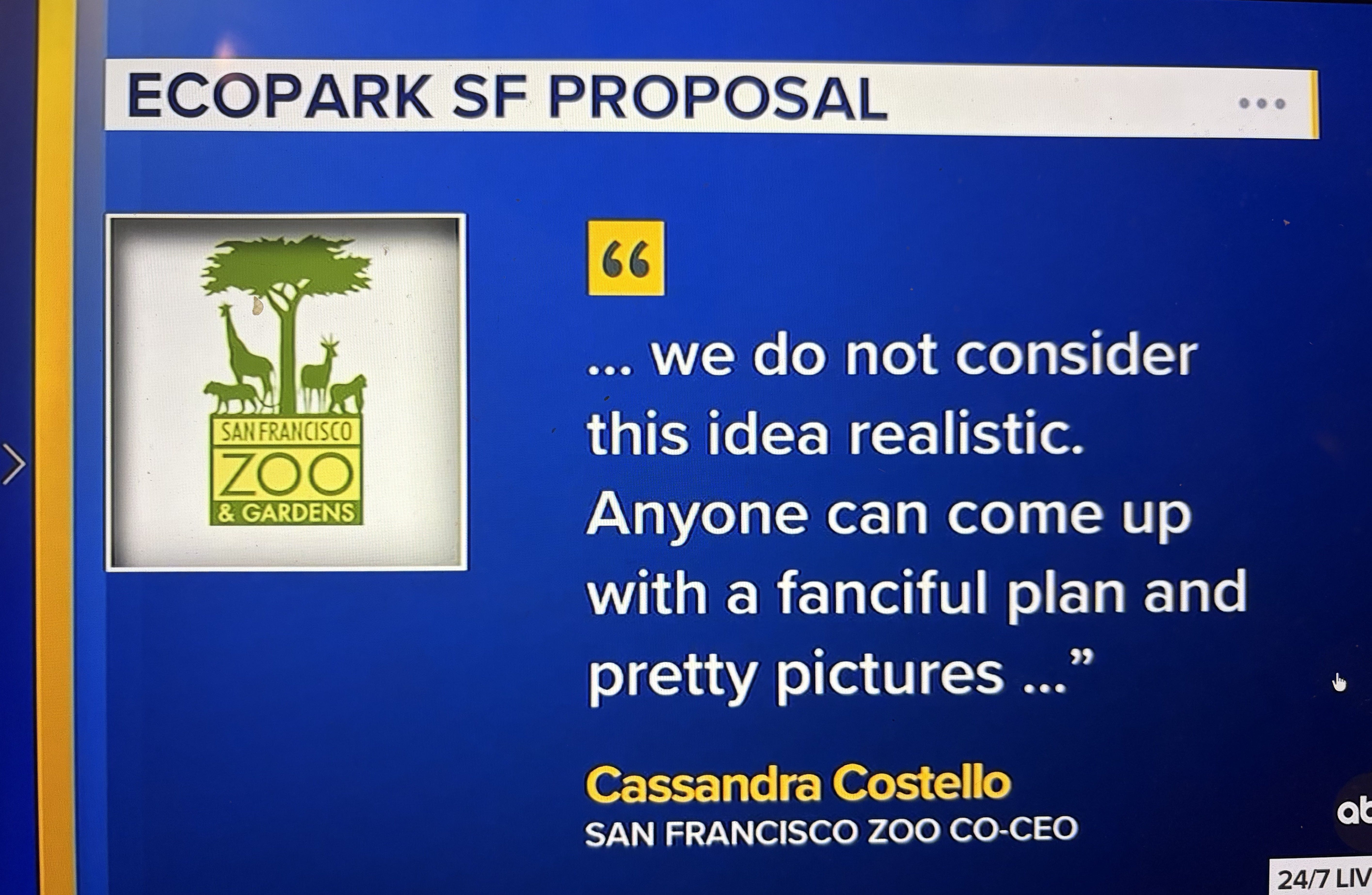
In response to the EcoPark SF proposal, San Francisco Zoo leadership issued the following statement to ABC7 News today:
“We do not consider this idea realistic. Anyone can come up with a fanciful plan and pretty pictures, but these images do not reflect the complexity or responsibility involved in caring for animals, conservation of species, and operating a major public institution.”
This response is deeply concerning and it reveals how far the current management is from the public it serves.
EcoPark SF is not a whimsical design exercise. It is an ambitious proposal led by San Franciscans and informed by a global team of veterinarians, progressive zoo leaders, conservation scientists, and former zoo executives — people with decades of experience working inside zoo systems and firsthand experience transitioning institutions away from traditional captivity models.
More troubling is what this response signals: that current leadership has little interest in listening to the public or thinking beyond the boundaries of a model that is already failing.
Polling shows that San Franciscans overwhelmingly support reimagining the zoo site and moving away from traditional captivity. Yet instead of engaging seriously with that mandate, the Zoological Society has chosen to circle the wagons, defend the status quo, and dismiss new ideas as unrealistic.
That’s not leadership. That’s rot.
Across the world, cities are rethinking what zoos can and should be. Buenos Aires has closed its traditional zoo and transformed it into an ecological park. Other institutions are shifting toward rescue, rehabilitation, habitat restoration, and immersive conservation education. These are not fantasies. They are operational realities.
Big challenges require big ideas.
Climate change, mass extinction, and evolving standards of animal welfare demand more than incremental upgrades to outdated infrastructure. They require institutions willing to rethink their purpose, governance, and relationship to the public.
The zoo’s response makes one thing clear: the San Francisco Zoological Society is not prepared to lead that transformation.
As I wrote in my op-ed in The San Francisco Standard:
The San Francisco Zoological Society has had decades to demonstrate responsible stewardship and has failed to do so, undermined by secrecy, budget mismanagement, and repeated animal welfare concerns. The city should end the contract and bring in mission-driven leadership aligned with modern standards. A great option is right across the bay: the Conservation Society of California, which runs the Oakland Zoo, is one of the most progressive, welfare-centered operators in the country.
If zoo leadership truly believes that bold thinking is unrealistic, then they are confirming what many already fear: that they are no longer capable of imagining — or delivering — a future that meets the ethical, environmental, and civic standards San Francisco expects.
EcoPark SF is not a rejection of responsibility. It is an invitation to finally take responsibility seriously.
And if the current operator cannot do that, the city must find one who can.