
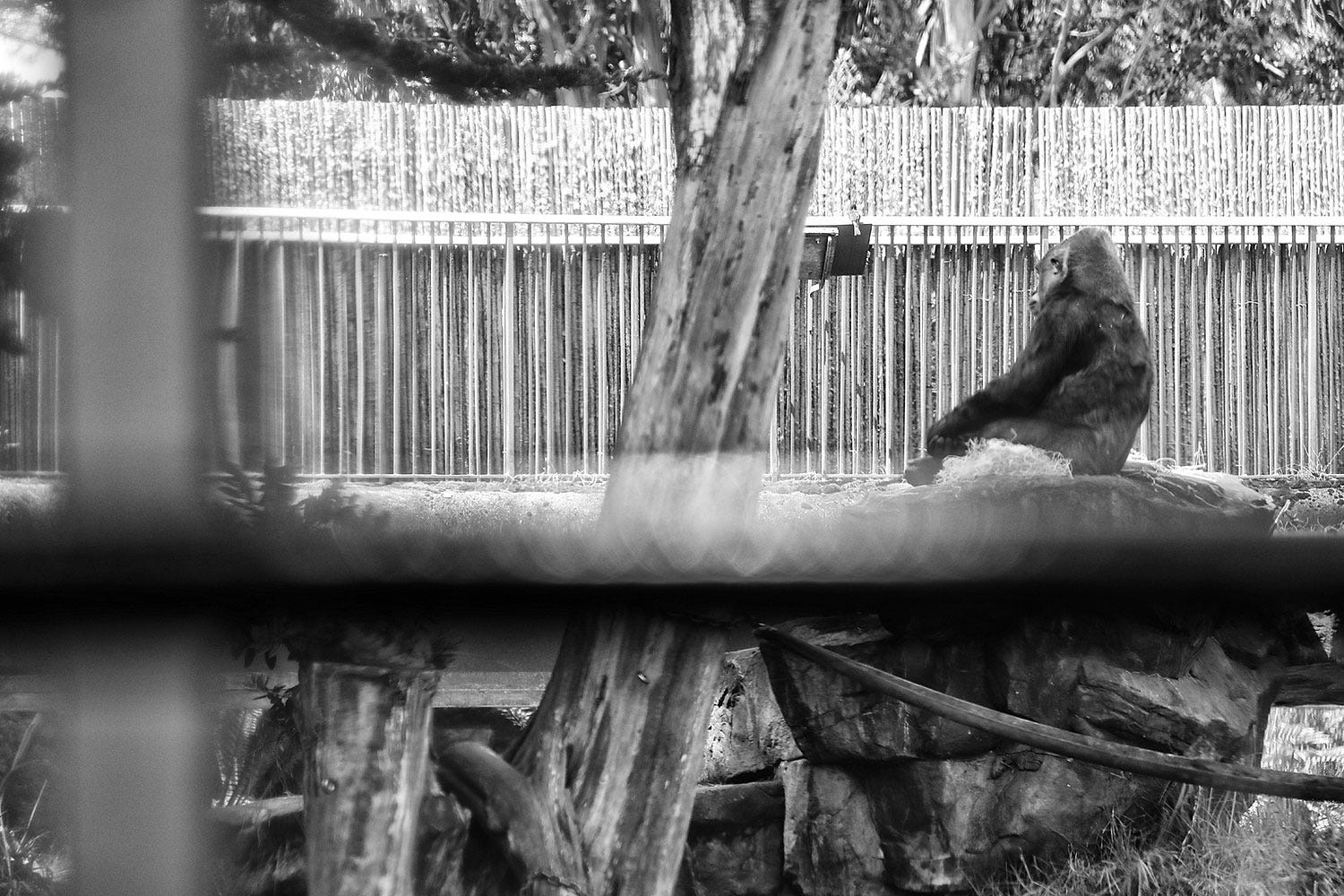
On August 12, 2025, at 9:30 a.m., a massive silverback named Cecil was introduced to the Jones Family Gorilla Preserve at the San Francisco Zoo. Public messaging framed him as calm, even-tempered — a hopeful new leader for the group.
Inside the building, staff were preparing for the opposite.
Cecil’s arrival had already been flagged internally as a “Significant Life Event” for the three resident females — Bawang, Monifa, and Kimani — meaning keepers expected major disruption to group stability and behavior. What followed was documented in welfare logs the zoo had refused to release for nearly two decades.
Those records show a newcomer under immediate strain: shaking, refusing food, prolonged displaying, hypervigilance, and repetitive anxiety behaviors. The stress spread quickly.
Bawang, the matriarch, began avoiding routine securing and pacing within a day. By Day Three, all three females were patrolling the moat together in a tight, alert formation — a threat response, not normal cohesion. Welfare scores dropped across motivation, feeding interest, and behavior.
Monifa withdrew, spending long periods out of sight and repeatedly yielding space. Kimani became reactive, cycling between freezing and sudden displays and seeking keeper proximity.
On September 1, keepers recorded a fight involving all three females causing injury to one — a pattern not documented before Cecil’s arrival.
The highest-risk introduction type
The way SF Zoo introduced Cecil matters. A 2025 peer-reviewed scoping review in Applied Animal Behaviour Science analyzing 35 studies across 25 papers found that welfare outcomes vary sharply by introduction type. Most critically, single-to-multiple introductions — one new animal added to an established group — are both the most commonly used and among the most strongly associated with negative welfare impacts, including stress and aggression. Multiple-to-multiple introductions showed fewer negative effects overall.
Cecil’s introduction followed this highest-risk structure exactly: one adult male introduced to three established adult females. And the zoo’s own logs track what the research predicts — early optimism, persistent stress behaviors, escalating tension, and rollback. After a mirror enrichment attempt, keepers recorded Cecil shivering from psychological overload, then wrote: “Cecil and girls separate, back to mesh to mesh.”
In plain language: the introduction failed.
Why push forward anyway?
Transfers like Cecil’s are typically driven by AZA Species Survival Plan breeding goals. Public materials described him as a genetic match and framed the move around future reproduction. But the same 2025 review makes the tradeoff explicit: negative welfare outcomes are not rare surprises — they are expected risks.
So when staff labeled Cecil’s arrival a Significant Life Event, and the data immediately showed unresolved stress, group destabilization, and repeated rollback, the ethical question becomes unavoidable:
If the welfare data says this is going badly, when — if ever — does breeding stop justifying continuation?
History already warned us
This isn’t an isolated incident. This is the same facility where Kabibe, a 16-month-old infant, was crushed by a hydraulic door in 2014. And where Oscar Jonesy, the longtime silverback, died in February 2025 after being anesthetized despite known heart disease — against guidance from the Great Ape Heart Project. His diagnosis wasn’t disclosed publicly for six months.
The newly released records show routine gate checks. But checklists don’t equal safety, and paperwork can’t compensate for aging infrastructure, understaffing, or high-stress animal movement.
Taken together, Kabibe’s death, Oscar’s death, and Cecil’s failed introduction point to the same pattern: preventable harm, delayed disclosure, and institutional momentum overriding welfare warnings.
What these records demand
The welfare concerns surrounding Cecil’s introduction weren’t an accident. They were the predictable outcome of a system built around breeding targets and population management, not the lived experience of individual animals.
Without these records, the story would remain what the zoo has told the media: that Cecil is calm, compatible, and settling in as expected.
But the documents show otherwise:
a newcomer whose stress has yet to resolve
three females whose stability collapsed
escalating conflict
and an introduction that had to be reversed
Cecil’s arrival didn’t strengthen the group. It destabilized it.
This story isn’t about blaming keepers doing difficult work. It’s about insisting that animal welfare data stop being treated as internal, optional, or PR-managed. Transparency isn’t a courtesy — it’s how the public verifies that the zoo’s decisions are informed by animal welfare.
Cecil’s story isn’t only about August 2025. It’s about what kind of zoo San Francisco is willing to fund — and what the animals deserve.